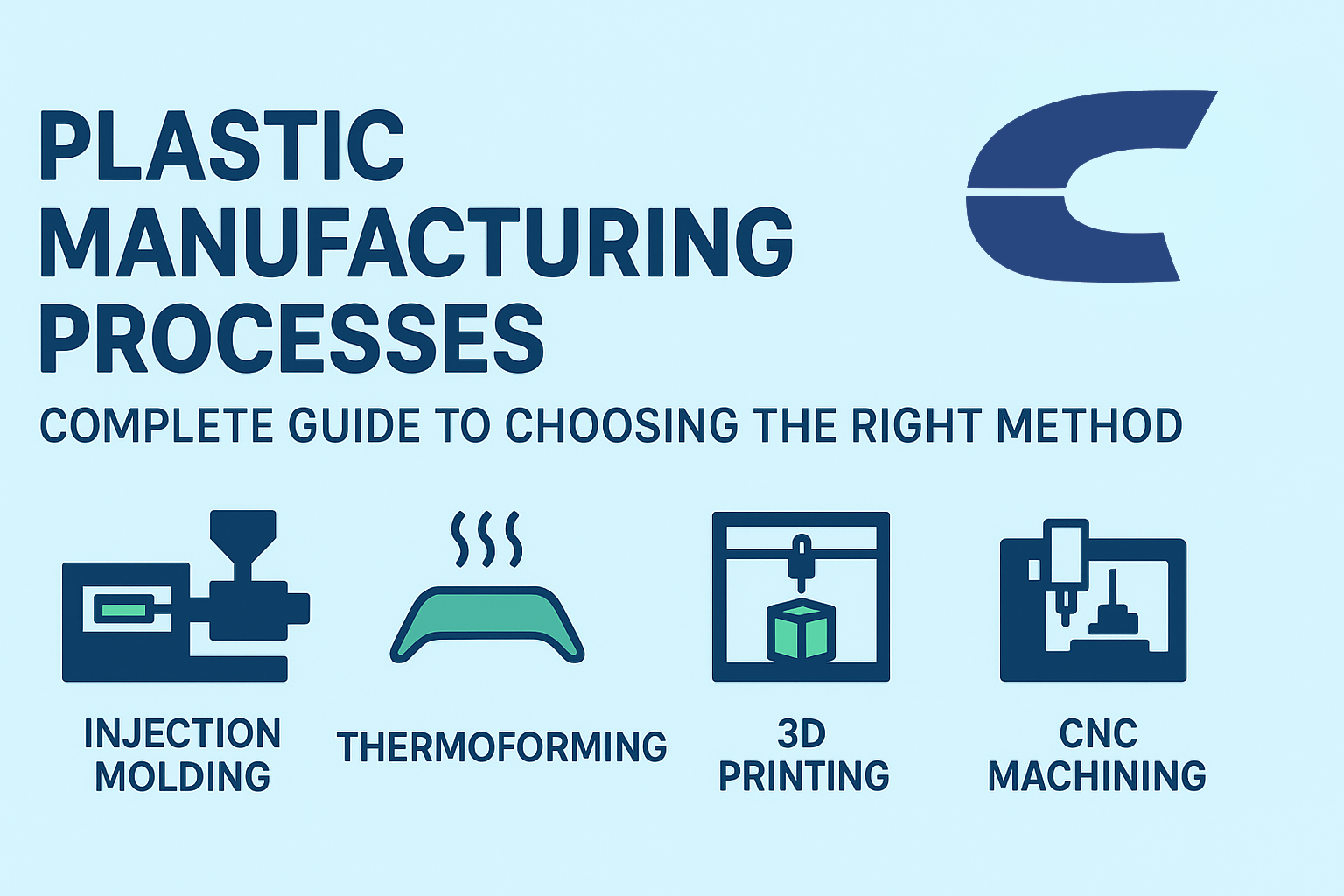
Plastics are the backbone of modern manufacturing, found in everything from automotive components to medical devices and consumer products. Choosing the right plastic manufacturing process is essential for cost, quality, and speed.
At Cary Products, we have helped businesses make these decisions for over 80+ years. This guide explains the most common plastic manufacturing processes and helps you choose the right method for prototypes or full-scale production.
How to Choose the Right Plastic Manufacturing Processes
Before we explore individual plastic manufacturing processes, you should first consider these four factors when selecting the right one:
1. Part Design and Complexity
Does your product have intricate features? Do you need close tolerances? Complex geometries can limit process options or require design adjustments to keep costs low. Fortunately, our design and engineering team at Cary Products can help you create your design manufacturable from the start.
2. Production Volume
Understand your production needs. Some processes have high tooling costs but low per-part costs at large volumes. In contrast, others have minimal setup costs but higher per-part prices.
Ask yourself the following questions:
- How many pieces are you manufacturing in a year?
- Is this a one-off or normal production?
- Will you need flexibility to change volumes?
3. Time to Market
Lead times vary across processes:
- Fast: Some operations deliver first parts within 24 hours
- Moderate: Tooling can take weeks
- Extended: High-volume tooling for production can require 2-4 months
4. Material Requirements
Identify performance needs:
- Resistance to mechanical stress and strain
- Temperature requirements
- Chemical resistance
- Aesthetic specifications (color, finish, texture)
- Regulatory requirements (FDA, automotive)
The right material balances cost against functional needs. Furthermore, with our ISO 9001:2015 certification, Cary Products assures consistent quality with each material selection.
Understanding Types of Plastics for Manufacturing Processes
Plastics fall into two main classes:
Thermoplastics
Thermoplastics are versatile, meltable, and reusable without significant degradation. Therefore, they are a good option for recyclable manufacturing.
Some common thermoplastics are:
- Polypropylene (PP)
- Polyethylene (PE)
- Acrylonitrile butadiene styrene (ABS)
- Polycarbonate (PC)
- Polyamide (Nylon/PA)
- Polyvinyl chloride (PVC)
- Acrylic (PMMA)
Thermoplastics work well with injection molding and thermoforming, two of Cary Products key services.
Thermosetting Plastics (Thermosets)
Thermosets cure chemically and form permanent bonds. They cannot be remelted, providing heat resistance and dimensional stability.
Some of the most common thermosets include:
- Epoxy resins
- Polyurethane
- Silicone
- Phenolic resins
Major Plastic Manufacturing Processes Explained
Injection Molding: High-Volume Plastic Manufacturing Process
Injection molding is the most popular plastic manufacturing process for mass production, and it’s one of Cary Products’ core specialties.
How Injection Molding Works
Plastic pellets melt in a heated barrel. The molten material is injected into a precise mold cavity under pressure. As it cools, the part hardens and solidifies. Finally, the mold opens and ejects the finished piece.
When to Use Injection Molding
Best For:
- High-volume runs (5,000+ parts)
- Complex geometries and close tolerances
- Repeatable, consistent quality
- Automotive, medical, consumer products
Injection Molding Benefits
- Low cost per part at volume
- Excellent surface finish and definition
- Low material waste
- Short cycle times
- Wide material selection
Injection Molding Considerations
- High initial tooling cost ($10,000-$100,000+)
- Long tooling creation lead times (2-4 months)
- Redesign requires new tooling
- Most economical in higher volumes
Why Choose Cary Products for Injection Molding
Cary Products Strength: Our experience in this plastic manufacturing process spans over 80+ years with state-of-the-art equipment helping customers achieve designs for manufacturability to a maximum extent, reducing tooling cost and improving part quality. Additionally, learn more about our process in our blog post on custom injection molding processes.
Thermoforming: Efficient Plastic Manufacturing Process for Medium Volumes
Thermoforming (or vacuum forming) is an adaptable plastic manufacturing process where heated plastic sheets are formed over tools under vacuum pressure.
How Thermoforming Works
A plastic sheet is first pressed into a frame. It is then heated until soft and pliable. Once ready, the sheet goes over a mold, and vacuum pressure pulls it into shape. After cooling, the part hardens and releases from the mold. Finally, excess material is trimmed away.
When to Use Thermoforming
Best For:
- Medium-volume production (200-5,000 pieces)
- Large, thin-walled parts
- Packaging, trays, enclosures
- Automotive interior components
- Custom healthcare items
Thermoforming Advantages
- Lower tooling cost compared to injection molding
- Faster tool development
- Ideal for bigger parts
- Economical for medium volumes
- Design flexibility
Thermoforming Considerations
- Limited to fairly simple geometries
- Requires uniform wall thickness
- Some material loss through trimming
- Less precise than injection molding
Why Choose Cary Products for Thermoforming
Cary Products Advantage: Our thermoforming complements injection molding, allowing flexibility in volumes and sizes. Custom parts meet exact specifications.
3D Printing: Rapid Prototyping Manufacturing Process
3D printing supports prototyping and low-volume production alongside our primary manufacturing services.
How 3D Printing Works
There are several technologies out there (FDM, SLA, SLS), but they all make parts layer by layer from digital CAD data.
When to Use 3D Printing
Best For:
- Rapid prototyping (1-100 parts)
- Complex geometries not achievable by other plastic manufacturing processes
- Real fast design iterations
- Low-volume custom parts
- Testing before tooling investment
3D Printing Advantages
- Parts in hours, not weeks
- No tooling required
- Design freedom
- Low start-up costs
- Perfect for prototyping and testing
3D Printing Considerations
- Higher cost per part. Additionally, production takes longer than molding. In some cases, material properties are more limited than molded parts. Finally, surface finish may require secondary processing.
When to Use 3D Printing
When to Use It: Cary Products has a number of customers who prototype with 3D printing prior to investing in injection molding tooling. As a result, this minimizes risk and gets the design correct before committing to production tooling.
CNC Machining: Precision Plastic Manufacturing Process
CNC machining removes material from solid blocks to create precise parts.
When to Use CNC Machining
Best For:
- Low to moderate volumes (1-5,000 parts)
- Very close tolerances
- Prototypes that need production-grade material
- Parts with complex machined features
CNC Machining Benefits
- No tool investment
- Very good tolerances and accuracy
- Wide range of materials
- Good for final-material prototypes
CNC Machining Considerations
- Higher per-part cost than molding. Also, material scrap can be significant. Because of this, cycle time tends to be longer, and certain geometries are difficult to produce.
Other Plastic Manufacturing Processes
Rotational Molding
Rotational molding creates hollow pieces by rotating a plastic powder-filled mold while it is heated. This process is ideal for larger parts with consistent wall thickness.
Best For:
- Large hollow pieces (tanks, containers, kayaks)
- Medium-sized orders (200-5,000 pieces)
- Even thickness walls
Polymer Casting
Liquid resin is poured into a mold and chemically cured to create pieces. This method works well for specialty applications.
Best For:
- Prototypes and small runs (1-1,000 pieces)
- Single or custom pieces
- Jewelry and dental uses
Extrusion
Plastic is pushed through a formed die to produce continuous profiles like pipes, tubes, and weather stripping. As such, this process is highly efficient for long, uniform shapes.
Best For:
- Continuous high-volume shapes
- Pipes, tubes, channels, trim
Blow Molding
Similar to glass blowing, hot plastic is blown inside a mold to create hollow parts. Consequently, this method excels at creating containers.
Best For:
- Bottles, containers, tanks
- High-volume production
Metal-to-Plastic Conversion: Advanced Manufacturing Process
Metal components can often be converted to plastic, saving cost and weight while maintaining performance.
Benefits of Metal-to-Plastic Conversion
- Weight reduction: 25-50% lighter than metal
- Cost saving: Lower material and manufacturing cost
- Design flexibility: Create complex geometries unavailable with metal
- Corrosion resistance: No rusting or oxidation
- Electrical insulation: Inherent insulator
- Lower noise operation: Less vibration and noise
Common Applications
- Automotive components (HVAC, brackets, housings)
- Industrial equipment parts
- Agricultural equipment components
- Consumer product enclosures
Why Choose Cary Products for Metal-to-Plastic Conversion
Cary Products possesses years of experience in determining metal parts suitability for plastic conversion. Our engineers can examine your parts and recommend whether conversion would be advantageous in your situation. Find out more by reading our blog post on benefits of metal-to-plastic conversion.
Comparing Plastic Manufacturing Processes: Decision Framework
Still undecided what plastic manufacturing process works best for you? Give this fast choice framework a try:
Choose Injection Molding if:
- 5,000+ parts
- Part complexity is medium to high
- Tight tolerances are required
- Lowest cost per-part
- Production will be in continuous runs
Apply Thermoforming if:
- 200-5,000 parts
- Parts are relatively large
- Geometry is easy to moderate
- Faster tooling turnaround is needed
- Cost-effectiveness is an issue at medium volumes
Apply 3D Printing if:
- You need prototypes urgently
- Volume is fewer than 100 parts
- Design is still in development
- Complex geometry is necessary
- You want to pilot before tooling investment
Apply CNC Machining if:
- Volume is fewer than 1,000 parts
- Very tight tolerances are necessary
- Prototypes in production material are needed
- Tooling investment must be avoided
Design for Manufacturing (DFM): Optimizing for Plastic Manufacturing Processes
Regardless of what plastic manufacturing process you are using, sound DFM is crucial. Without it, you risk:
- Too much tooling cost
- Production delays
- Quality issues
- Higher per-part cost
DFM Best Practices
- Uniform wall thickness: Avoids warping and sink marks
- Appropriate draft angles: Part ejection is easy
- Round corners: Reduces stress concentrations
- Don’t have undercuts: Or design them intentionally
- Cut in material flow: Gate and runner design intelligently
Cary Products DFM Services
Our engineers review each project for manufacturability before tooling. Utilizing cutting-edge 3D design software, we can identify potential issues and suggest optimizations that conserve time and expense.
Industry-Specific Plastic Manufacturing Processes
Different industries have particular requirements for plastic manufacturing processes and components:
Automotive Manufacturing
Parts in automobile manufacturing require:
- Heat resistance
- Impact strength
- Chemical resistance (fuels, oils)
- Dimensional stability
- Regulatory compliance (FMVSS standards)
Cary Products has extensive experience with automobile plastics, namely HVAC components and under-hood applications. Notably, since the 1950s, our founder Arthur Cary Jr. played a major role in creating automotive HVAC systems using plastic injection molding technology.
Medical and Healthcare
Manufacturing of medical devices demands:
- Biocompatibility
- Sterilizable
- Compliance with FDA
- Lots traceability
- Clean room production (for some applications)
Energy Sector
Energy applications demand:
- UV resistance
- Resistance to high temperatures
- Impact resistance
- Long-term durability
Agriculture
Agricultural components are targeted for:
- Weather resistance
- Durability against impacts
- Cost-effectiveness
- Reducing product waste
Construction
Construction applications demand:
- Structural strength
- UV stability
- Long life
- Affordable manufacturing
Consumer Products
Consumer products emphasize:
- Aesthetic quality
- Cost-effectiveness
- Brand consistency
- Quick time-to-market
Quality Assurance in Plastic Manufacturing Processes
Quality is not an accident, it builds into each plastic manufacturing process. At Cary Products, our ISO 9001:2015 certification guarantees repeatable, documented quality management in every operation.
ISO 9001:2015 is the international quality management system (QMS) standard. Specifically, it provides a system that ensures organizations produce products and services that meet customer specifications and regulatory requirements. With over one million certificates issued worldwide, ISO 9001 is the most widely used quality management standard.
Our Quality Processes
- First article inspection
- In-process quality inspections
- Statistical process control
- Final inspection and testing
- Dimensional verification
- Material certification and traceability
What ISO 9001:2015 Certification Means for You
- Reliable quality in each production batch
- Traceability based on documented procedures
- Company culture of continuous improvement
- Risk prevention and control
- Focus on customer satisfaction
Learn more about ISO 9001 requirements and benefits and why certification is key to manufacturing excellence.
Collaborating with Cary Products
When you partner with Cary Products, you get manufacturing plus – 80+ years of expertise in plastic manufacturing processes to guide your project from idea to final production.
Our Process
1. Design Review and Consultation
We begin by discovering your requirements, reviewing designs, and recommending the most effective plastic manufacturing processes and materials. Contact us to get started.
2. Optimization and Engineering
Our engineers design your product for manufacturability using state-of-the-art 3D design software, identifying possible issues before they become problems.
3. Tooling Development
For injection molding and thermoforming, we build precise tooling for long-term production reliability in our tooling facility.
4. Approval and Sampling
First article samples are developed for your approval before production to verify that everything is to specifications before full production begins.
5. Production and Quality Control
Parts are produced with strict quality control at each step, supplemented by our ISO 9001:2015 certification.
6. Support and Delivery
Parts are shipped on time, with ongoing support for future production runs.
Sustainable Plastic Manufacturing Processes
Modern manufacturing today must balance performance with being environmentally friendly. Cary Products is committed to sustainable plastic manufacturing processes:
- Material efficiency: Design for minimum waste
- Recycling programs: Compatible thermoplastic scrap recycling
- Energy efficiency: New equipment saves energy
- Local manufacturing: Production in Texas reduces transport emissions
- Long-lived products: Quality parts cut down on replacement
Cutting waste and making production more efficient, the EPA’s sustainable manufacturing principles state, not only help the environment but also save operating costs.
Common Problems with Plastic Manufacturing Processes
Problem: High Tooling Costs
Solution: Consider thermoform for medium runs, 3D print for prototypes, or phase tooling approaches that spread costs over time. We can help you see the most cost-effective path.
Challenge: Long Lead Times
Solution: Work with an experienced partner like Cary Products who can speed the process through efficient DFM and sound project management.
Challenge: Material Selection
Solution: Collaborate with material experts who understand the mechanical, thermal, and chemical requirements of your application. Our team has decades of experience matching materials to applications.
Challenge: Volume Uncertainty
Solution: Start with lower-volume plastic manufacturing processes (thermoforming, machining) and transition to injection molding as volumes increase and demand becomes established.
Challenge: Design Iterations
Solution: Prototype through 3D printing or machining before investing in production tooling. Ultimately, it is cheaper and faster in the long run.
FAQ About Plastic Manufacturing Processes
Q: How do I know which plastic manufacturing process is most cost-effective for my project?
A: It will be a function of your volume requirements. Generally speaking, injection molding is the most cost-effective in quantities of more than 5,000 pieces, thermoforming is appropriate for 200-5,000 pieces, and small quantities may be best matched by 3D printing or machining. Contact our personnel for a specialized evaluation.
Q: How long does it take to create injection molding tooling?
A: Normal lead times are 8-16 weeks depending on complexity. Simple tools may be faster, but sophisticated multi-cavity tools require longer. Our experienced tooling team can provide accurate quotes for your specific project.
Q: Do you provide design optimization?
A: Yes, definitely! Our engineering team reviews all design for manufacturability and suggests optimizations to reduce cost and improve quality.
Q: Do you have prototyping capability?
A: While production manufacturing is our forte, we can produce prototype quantities utilizing our thermoforming and injection molding operations. Additionally, we also engage prototyping specialists on an individual case basis.
Q: What certifications does Cary Products have?
A: We’re ISO 9001:2015 certified, with consistent quality management systems across all operations. This certification demonstrates our commitment to quality, continuous improvement, and customer satisfaction.
Q: Can metal parts be converted to plastic?
A: Our metal-to-plastic conversion service evaluates parts for conversion opportunities that reduce weight and expense without sacrificing performance. Learn more in our blog post on metal-to-plastic conversion.
Q: What is the minimum order quantity?
A: It varies by process and application. Call us to discuss your volume requirements—we make small batches to large quantities.
Q: Where is Cary Products?
A: We are located in Hutchins, Texas, with customers in North America and globally. With our Texas location, we are able to provide economical logistics and lead times.
The Future of Plastic Manufacturing Processes
Plastic manufacturing processes continue to evolve with advancements in:
- Smart manufacturing: IoT sensors and data analytics make production more streamlined
- Sustainable materials: Bio-based content and recycled content plastics
- Automation: AI and robotics increase efficiency and consistency
- Advanced materials: Engineering plastics with higher performance
- Additive manufacturing integration: Hybrid approaches combining 3D printing with traditional methods
Cary Products is always at the forefront of such innovations, consistently investing in technology and expertise to provide our customers with the best solutions. Learn more about manufacturing trends from industry sources like the Society of Manufacturing Engineers.
Ready to Choose Your Plastic Manufacturing Process?
Choosing the right plastic manufacturing process is a key decision that impacts cost, quality, schedule, and success. With over 80+ years of success, up-to-date facilities, and ISO 9001:2015 certification, Cary Products has the knowledge to guide your project from concept to production.
High-volume injection molding, medium-volume thermoforming, or seasoned consultation on manufacturing strategy, no matter what you need, our team are ready to help.
Call Cary Products today to discuss your project:
- Get expert process selection guidance
- Get design optimization recommendations
- Get accurate quotes for your use
- Learn how we can bring your product to life
Design for Manufacturing (DFM): Best Practices in Plastic Production
- Meet Our Expert Team
- View Our Industry Applications
- Read Our Latest News & Insights
- Explore Our Services
Cary Products | Texas-Based Precision Plastic Manufacturing Since 1946 | ISO 9001:2015 Certified | Injection Molding | Thermoforming | Design & Engineering | Contact Us